Paranoid (Live at Live Aid, John F. Kennedy Stadium, 13th July 1985) by Black Sabbath
The riff that never dies: Remembering Ozzy with Black Sabbath’s “Paranoid” at Live Aid
Before Metallica and Guns N’ Roses, there was Deep Purple and Black Sabbath. And at the heart of Black Sabbath, a primal force of nature howling into the microphone, was Ozzy Osbourne. It is with an incredibly heavy heart that we mark today, July 22, 2025, as the day the music world lost its Prince of Darkness. Ozzy has passed away.
The news feels unreal. For decades, Ozzy was the man who cheated death, a walking paradox of chaos and longevity. To process this monumental loss, we’re not turning to a polished studio track. We’re going to a moment raw, powerful, and historic: the original Black Sabbath lineup reuniting for “Paranoid” at Live Aid in 1985.
The story of the song “Paranoid” is legendary in itself. It was a last-minute filler track, written in a matter of minutes to round out their second album. It wasn’t meant to be the main event. Yet, that frantic, driving, three-minute blast of anxiety and desperation became their most famous song, an accidental anthem that would define a genre.
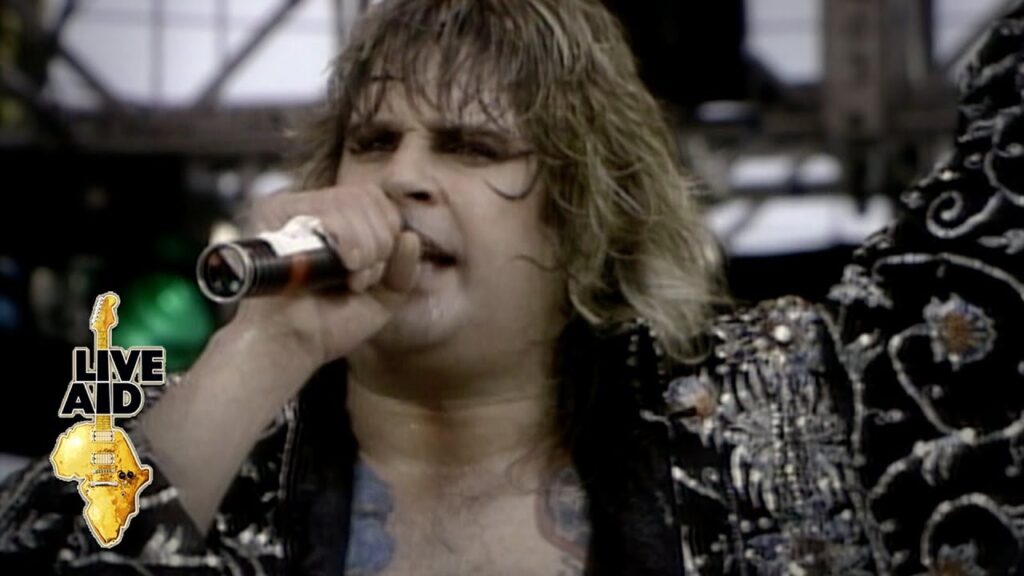
Fast forward to July 13, 1985. The location is JFK Stadium in Philadelphia. For the first time in seven years, the four men who forged heavy metal in the fires of industrial Birmingham stood on a stage together: Ozzy Osbourne, Tony Iommi, Geezer Butler, and Bill Ward. After tearing through “Children of the Grave” and “Iron Man,” they launched into their finale.
From the first staccato notes of Bill Ward’s drumming, the energy is electric. Then comes that riff from Tony Iommi—a sound so iconic it feels like it’s part of the human genome. Geezer Butler’s bass gallops alongside it, a thundering heartbeat. And then there’s Ozzy.
He’s a whirlwind of manic energy, clad in purple, clapping his hands above his head, urging the sun-drenched stadium crowd to go wild. “Can you hear me!” he screams. His voice isn’t perfect, but that’s not the point. It’s pure, unfiltered Ozzy. When he yells, “Finished with my woman ‘cause she couldn’t help me with my mind,” it’s not just a lyric; it’s a primal scream from the soul of rock and roll.
This performance wasn’t slick. It was raw, a little ragged, and utterly brilliant. It was four masters of their craft reconnecting with the lightning they’d captured in a bottle 15 years earlier. Watching it today, it feels less like a concert and more like a moment of cosmic realignment. It was a reminder to the world, then dominated by synth-pop and glam, of the raw power of the riff. It was a reminder that Sabbath was, and always will be, the source code.
Ozzy Osbourne gave us the soundtrack for our rebellion, our confusion, and our joy. He was a frontman, an icon, a survivor, and an entertainer in the truest sense of the word. He made us feel like it was okay to be an outsider. Today, the world feels a lot quieter and a lot less fun without his signature cackle.
So turn this one up. Turn it up loud. For Ozzy.
Listen: Paranoid Live At Live Aid John F Kennedy